
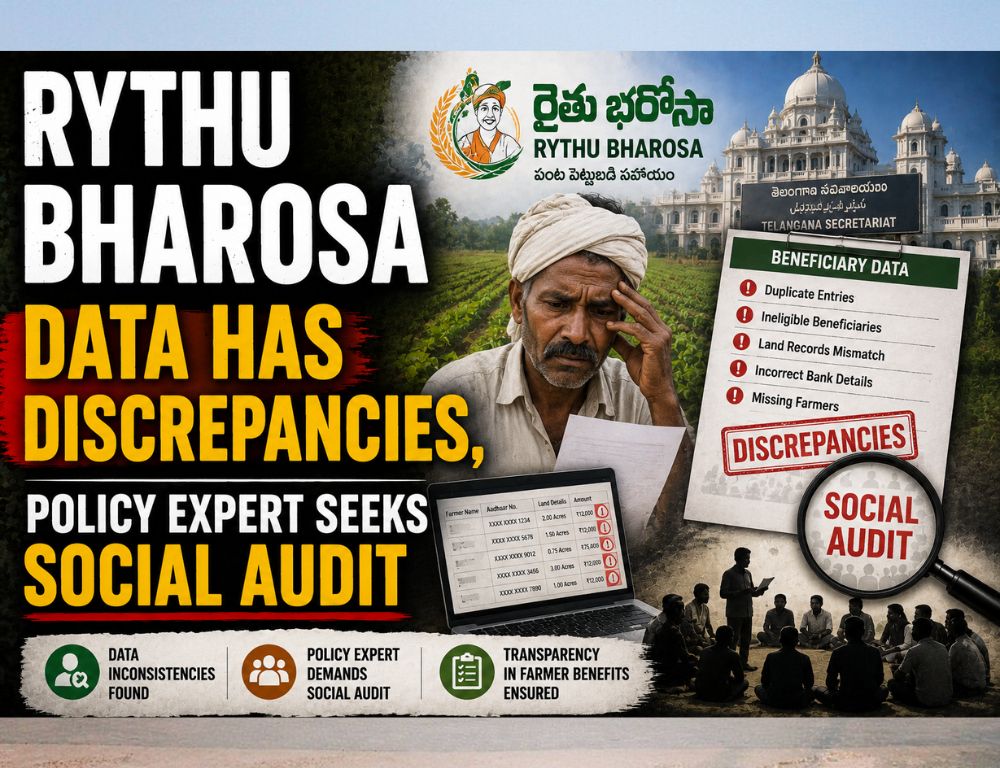
<p>HYDERABAD: A public policy expert has sought disaggregated beneficiary data and an independent social audit of Rythu Bharosa disbursements from 2018-19 onwards, alleging discrepancies in the Telangana government’s officially published figures. Representation seeks panchayat-level beneficiary lists and payment details Dr Donthi Narasimha Reddy, in a representation to chief secretary Sanjay Jaju dated August 1, 2026, [...]<content:encoded><![CDATA[ <p class="isSelectedEnd"><strong>HYDERABAD: </strong>A public policy expert has sought disaggregated beneficiary data and an independent social audit of Rythu Bharosa disbursements from 2018-19 onwards, alleging discrepancies in the Telangana government’s officially published figures.</p> <h2>Representation seeks panchayat-level beneficiary lists and payment details</h2> <p class="isSelectedEnd">Dr Donthi Narasimha Reddy, in a representation to chief secretary Sanjay Jaju dated August 1, 2026, sought village and panchayat level beneficiary lists for every disbursement season since the scheme was launched as Rythu Bandhu in 2018-19.</p> <p class="isSelectedEnd">Reddy said the scheme was renamed Rythu Bharosa on January 26, 2025, but argued that the two periods should be treated as one continuous record for disclosure and audit purposes.</p> <p class="isSelectedEnd">The representation sought details including beneficiary names, survey numbers, extent of land covered, amount disbursed and date of payment for each season.</p> <h2>Representation flags gaps in official figures</h2> <p class="isSelectedEnd">Reddy alleged that the government’s published year-wise summary contained several inconsistencies. These included an approximately ₹13 crore difference between the calculated and reported disbursement for the 2023-24 Vanakalam season.</p> <p class="isSelectedEnd">He also pointed to the absence of farmer, acreage and disbursement figures for the 2024-25 Vanakalam season. The representation sought an explanation for the missing data.</p> <p class="isSelectedEnd">According to the representation, figures for the same scheme in different sections of the official document differed by about ₹2,000-2,500 crore a year for 2023-24 through 2026-27, although the multi-year totals were close.</p> <p class="isSelectedEnd">Reddy also flagged a fall in the average land extent covered per farmer. He said the figure had remained between 2.1 and 2.7 acres per farmer across 12 seasons from 2018-19 to 2023-24, before falling to 1.33-1.48 acres in the two most recent Yasangi seasons.</p> <p class="isSelectedEnd">The representation linked this change to an acreage cap described in the official document as "Vanakalam (Phase 4 - Upto 4 Acres)" and sought details of the government order under which the cap was introduced.</p> <p class="isSelectedEnd">Reddy said the government should publish a reconciliation statement explaining the discrepancies and the methodology used to compile and revise beneficiary, acreage and payment figures.</p> <h2>Demand for tenant farmer data and crop-wise impact assessment</h2> <p class="isSelectedEnd">The representation also sought separate data on tenant farmers covered under Rythu Bharosa, including the number identified as eligible, enrolled and paid season-wise after the January 2025 policy change.</p> <p class="isSelectedEnd">It sought details of the lease-verification process and a comparison of the number enrolled with independent estimates of the tenant-cultivator population in Telangana.</p> <p class="isSelectedEnd">Reddy further demanded a crop-wise cost-of-cultivation impact assessment covering major crops such as paddy, cotton, maize and pulses. The assessment, he said, should show cultivation costs, the applicable per-acre support and the percentage of cultivation costs covered by the scheme.</p> <p class="isSelectedEnd">The representation also sought year-on-year data to show how the real value of the support has changed as cultivation costs increased.</p> <p class="isSelectedEnd">For social audits, Reddy proposed displaying beneficiary lists at Gram Panchayat offices and conducting Gram Sabha-level audits through independent social audit teams. He also sought an outcome-mapping report linking Rythu Bharosa payments with cropping patterns, yields and indebtedness or distress-sale indicators.</p> Reddy requested the government to furnish the information within the statutory period under the Right to Information Act, 2005, and publish a time bound plan for panchayat-level social audits of the scheme. ]]>
This is a summary. For the full story, refer to the original source. Public of India presents verified citizen-relevant reporting.